
Hiring a veterinarian in Texas (2026): what the numbers say about supply, pay and where the gaps are
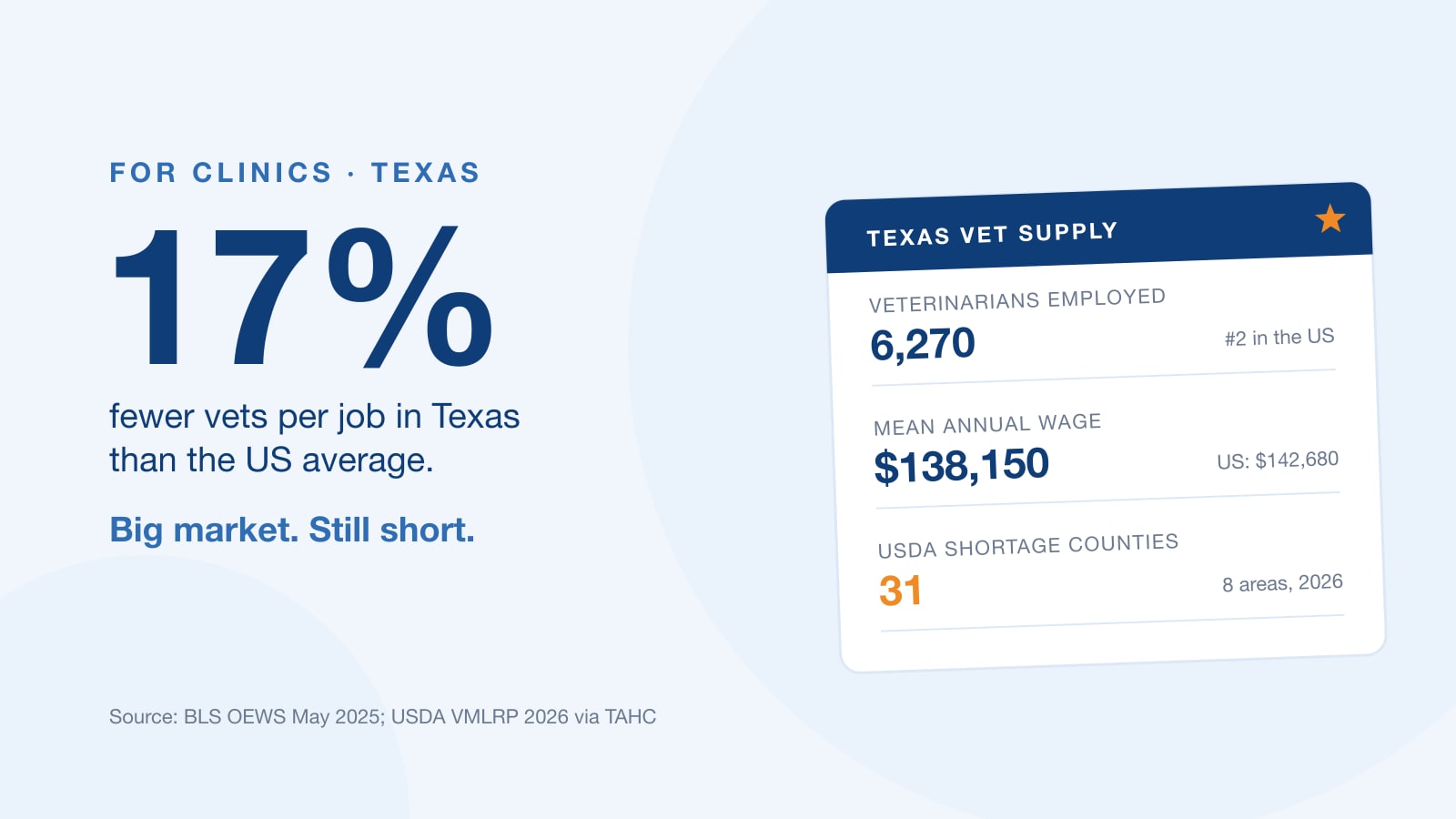
The short answer: Texas has a lot of veterinarians and still not enough of them. The Bureau of Labor Statistics counts 6,270 veterinarians employed in Texas as of May 2025, second only to California. But measured against the size of the Texas economy, that headcount is thin. Texas has a location quotient of 0.83 for veterinarians, which means about 17% fewer vets per job than the national average. A Texas clinic is competing in a big market that is still under-supplied.
The Texas numbers
Employment: 6,270 veterinarians in Texas, against 9,170 in California, 5,360 in Florida and 83,900 nationwide (BLS Occupational Employment and Wage Statistics, May 2025).
Density: 0.446 veterinarians per 1,000 jobs in Texas, a location quotient of 0.83. Population and pet ownership have grown faster than the doctor supply.
Pay: the annual mean wage for Texas veterinarians is $138,150, against $142,680 nationally. The Texas median, $131,330, sits almost exactly on the national median of $130,100. Texas pays at the national level, not above it, so a Texas practice cannot count on salary alone to pull doctors in from higher-paying states. Our salary by state breakdown shows where Texas sits on the full map.
Where the gaps are sharpest
For 2026, USDA's Veterinary Medicine Loan Repayment Program designated eight shortage situations in Texas covering 31 counties, according to the Texas Animal Health Commission. The list is not only remote ranch country. It includes Denton and Williamson counties on the edges of Dallas-Fort Worth and Austin, Bell County around Killeen and Temple, Potter County around Amarillo, and Webb, Starr, Zapata and Jim Hogg counties along the border.
Those designations are for food animal medicine, so they do not measure companion animal demand. They do show where the state and USDA agree that doctors are missing, and where a clinic hiring for a mixed or large animal seat is fighting the hardest. Veterinarians who commit three years to a designated area can receive up to $40,000 a year in loan repayment, up to $120,000 in total, and clinics in those areas can apply for USDA Veterinary Services Grant Program funds of up to $200,000 for rural practice enhancement.
New graduate supply is growing, slowly
Texas now trains doctors at two veterinary schools. Texas A&M has long been one of the largest programs in the country, and Texas Tech's School of Veterinary Medicine in Amarillo graduated its first class of 61 doctors in May 2025 and earned full AVMA accreditation in October 2025. Texas Tech built its program around rural and regional practice, which should help the Panhandle over time.
But a new school adds one class a year, and every Texas clinic is recruiting from the same graduating classes as every corporate group in the state. The AVMA's 2025 Graduating Senior Survey found that nearly 60% of new graduates had full-time jobs lined up before graduation. If you are hiring in the spring, most of the class has already chosen.
What it takes to practice in Texas
Texas licenses veterinarians through the Texas Board of Veterinary Medical Examiners. The standard path is a degree from an AVMA-accredited school, a passing score on the NAVLE and a passing score on the Texas State Board Exam. That standard applies to every doctor, wherever they trained.
That matters for international hiring. All five Canadian veterinary schools are AVMA-accredited, and so is UNAM's veterinary school in Mexico City for the 2011 to 2025 graduating classes. Graduates of those programs sit the same NAVLE as Texas A&M and Texas Tech graduates and are licensed on the same footing. Our UNAM accreditation explainer covers that window in detail.
Why Texas is the natural state for cross-border hiring
No state shares more of the border with Mexico than Texas. Monterrey is a few hours from Laredo. A Mexican veterinarian placed in San Antonio, the Rio Grande Valley or a West Texas practice is closer to family than one placed almost anywhere else in the country, and that proximity is a real retention advantage.
Texas also has one of the largest Spanish-speaking populations in the US. A bilingual doctor is an asset in the exam room for clients who are more comfortable explaining a sick pet in Spanish, and for the many Texas practices with Spanish-speaking technicians and support staff.
Veterinarians from Canada and Mexico qualify under the USMCA TN category, which has no lottery and no annual cap. Our guides to hiring Canadian veterinarians and hiring an international veterinarian lay out how each route works for a clinic.
What a Texas clinic should do now
Price the vacancy before you price the hire. Every month a seat sits empty costs production, and our breakdown of what an empty DVM seat costs puts numbers on it.
Recruit earlier in the graduation cycle, and stop relying on salary alone. Texas pays at the national level, so the case for your clinic has to rest on caseload, mentorship and schedule.
Widen the pool. The domestic supply is the same for every clinic in your market. A doctor from Canada or Mexico, licensed through the same Texas standard, is a candidate your competitors are not calling.
What VetBridge USA handles
VetBridge USA sources veterinarians from Canada and Mexico for independent US practices, matches them to your opening, and coordinates state licensing and the TN process end to end, so your team is not learning immigration paperwork on the job. You interview and you decide who you hire.
Sources
Texas, California, Florida and national employment, location quotient and wage figures come from the US Bureau of Labor Statistics, Occupational Employment and Wage Statistics, May 2025, occupation 29-1131 Veterinarians. Shortage areas and program amounts come from the Texas Animal Health Commission release of February 2, 2026 on the USDA Veterinary Medicine Loan Repayment Program and Veterinary Services Grant Program. Texas Tech graduation and accreditation facts come from Texas Tech University and the Office of the Texas Governor (May and October 2025). New graduate employment comes from the AVMA 2025 Graduating Senior Survey. Licensing requirements come from the Texas Board of Veterinary Medical Examiners. School accreditation comes from the AVMA Council on Education, the NAVLE is administered by the International Council for Veterinary Assessment, and TN eligibility for veterinarians comes from USCIS, TN USMCA Professionals.
Questions clinics ask
Is there a veterinarian shortage in Texas?
Yes, by several measures. The BLS counts 6,270 veterinarians in Texas as of May 2025, but the state's location quotient of 0.83 means about 17% fewer vets per job than the national average. For 2026, USDA designated eight veterinary shortage situations in Texas covering 31 counties, according to the Texas Animal Health Commission.
How much do veterinarians make in Texas?
The BLS reports an annual mean wage of $138,150 for Texas veterinarians as of May 2025, against $142,680 nationally. The Texas median of $131,330 is close to the national median of $130,100, so Texas pays at roughly the national level.
Can a veterinarian from Mexico or Canada get licensed in Texas?
Yes, through the same standard as any other applicant. The Texas Board of Veterinary Medical Examiners licenses graduates of AVMA-accredited schools who pass the NAVLE and the Texas State Board Exam. All five Canadian schools are AVMA-accredited, as is UNAM in Mexico City for its 2011 to 2025 graduates.
Which Texas counties are veterinary shortage areas?
USDA's 2026 Veterinary Medicine Loan Repayment Program designations in Texas cover 31 counties, including Denton, Williamson, Bell, Potter, Webb, Starr, Zapata and Jim Hogg. The designations are for food animal practice. The Texas Animal Health Commission nominates the areas and USDA publishes the official map.