
Hiring a veterinarian in New York (2026): thin supply, uneven pay and the state's built-in bridge
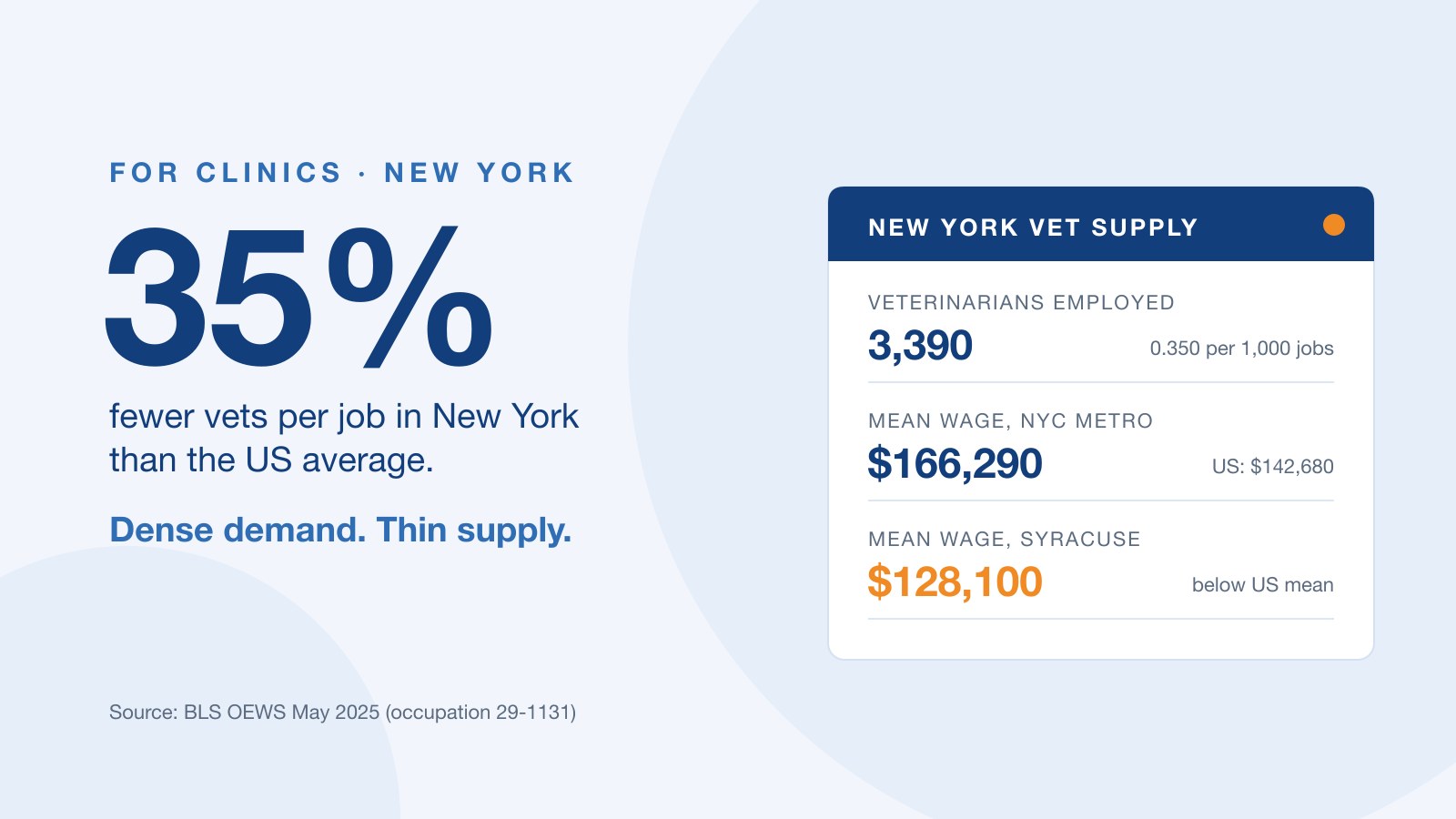
The short answer: New York is one of the thinnest veterinary markets in the country relative to its economy. The Bureau of Labor Statistics counts 3,390 veterinarians employed in New York as of May 2025. That is 0.350 vets for every 1,000 jobs, against 0.540 nationally, which works out to a location quotient of about 0.65, or roughly 35% fewer veterinarians per job than the US average. A New York clinic is hiring in a market where demand is dense and doctors are not.
The New York numbers
Employment: 3,390 veterinarians statewide, against 9,170 in California, 6,270 in Texas and 83,900 nationwide (BLS Occupational Employment and Wage Statistics, May 2025).
Density: 0.350 veterinarians per 1,000 jobs in New York, compared with 0.540 for the US as a whole. Texas, a state we covered in our Texas hiring breakdown, sits at 0.446. New York is well below both.
Pay: the annual mean wage for New York veterinarians is $151,530, against $142,680 nationally. The New York median, $131,830, is almost identical to the national median of $130,100. That is the surprising part. Across all occupations, New York's mean wage runs about 18% above the national figure ($82,460 versus $69,770). For veterinarians the gap is only about 6% at the mean and about 1% at the median. Relative to what other New York professionals earn, veterinary pay in the state is not keeping up.
Two very different hiring markets
New York is really two markets, and the BLS metro data shows it clearly.
Downstate, the New York-Newark-Jersey City metro area employs 3,150 veterinarians at an annual mean wage of $166,290 and a median of $156,150, about 20% above the national median. Density is still low at 0.331 vets per 1,000 jobs. Pay is high there, but so is the cost of living, and a practice is competing with specialty hospitals, emergency groups and corporate chains for the same doctors.
Upstate, pay drops below the national level. The annual mean wage is $131,230 in Buffalo-Cheektowaga, $130,790 in Rochester and $128,100 in Syracuse, all more than $10,000 under the national mean of $142,680. Albany-Schenectady-Troy is the exception, with a mean of $152,200 and a density of 0.628 vets per 1,000 jobs, above the national average. Our salary by state breakdown puts these figures in national context.
For an upstate clinic, the math is hard: below-average pay in a state with a below-average supply of doctors. Salary alone will not close that gap.
New graduate supply
New York trains veterinarians at two schools. Cornell's College of Veterinary Medicine enrolled an incoming class of 128 for the class of 2029, according to its 2025 annual report, and 48% of that class are New York residents. Long Island University's Lewyt College of Veterinary Medicine opened in 2020 and graduated its first class in 2024.
That pipeline is real, but every New York practice, specialty hospital and corporate group recruits from it. The AVMA's 2025 Graduating Senior Survey found that nearly 60% of new graduates had full-time jobs lined up before graduation. A clinic that starts recruiting in the spring is choosing from what is left.
What it takes to practice in New York
New York licenses veterinarians through the State Education Department's Office of the Professions. The standard requirements are a degree from an AVMA-accredited program (or one the Department approves), a passing score on the NAVLE, good moral character and a minimum age of 21. Graduates of programs outside the AVMA-accredited system face additional requirements.
That matters for international hiring. All five Canadian veterinary schools are AVMA-accredited, and so is UNAM's veterinary school in Mexico City for its 2011 to 2025 graduating classes. Those graduates sit the same NAVLE as Cornell graduates and qualify on the same footing. Our UNAM accreditation explainer covers that window.
New York's built-in bridge: the limited permit
New York also has a tool most states do not. The State Education Department can issue a limited permit to an applicant who meets every licensure requirement except the exam, allowing that veterinarian to practice under the supervision of a New York licensed veterinarian. It is time-limited and designed as a bridge to the NAVLE, not a substitute for it.
For a practice with at least one stable licensed doctor, that changes the timeline. A qualified veterinarian can start seeing patients under supervision while the license finishes, instead of waiting out the whole process before day one. Our guide to New York's limited veterinary permit covers what it makes possible and where its limits are.
What a New York clinic should do now
Price the vacancy first. Every month a seat sits empty costs production, and our breakdown of what an empty DVM seat costs puts numbers on it.
Know which market you are in. A downstate clinic is competing on pay against large employers. An upstate clinic is competing against the higher wages downstate and in neighboring states. Either way, caseload, mentorship and schedule have to carry part of the offer.
Widen the pool. The domestic supply is the same for every clinic in your region. A veterinarian from Canada or Mexico, licensed through the same New York standard, is a candidate your competitors are not calling, and the limited permit can shorten the time to a first appointment.
What VetBridge USA handles
VetBridge USA sources veterinarians from Canada and Mexico for independent US practices, matches them to your opening, and coordinates state licensing and the TN process end to end, with immigration work handled by licensed independent attorneys. You interview and you decide who you hire.
Sources
New York, metro area, comparison state and national employment and wage figures come from the US Bureau of Labor Statistics, Occupational Employment and Wage Statistics, May 2025, occupation 29-1131 Veterinarians; the location quotient is calculated from those figures. All-occupation wage comparisons come from the same release. Cornell class figures come from the Cornell University College of Veterinary Medicine Annual Report 2025. LIU facts come from Long Island University. New graduate employment comes from the AVMA 2025 Graduating Senior Survey. Licensing requirements and the limited permit come from the New York State Education Department, Office of the Professions. School accreditation comes from the AVMA Council on Education, the NAVLE is administered by the International Council for Veterinary Assessment, and TN eligibility for veterinarians comes from USCIS, TN USMCA Professionals.
Questions clinics ask
Is there a veterinarian shortage in New York?
By supply relative to the economy, yes. The BLS counts 3,390 veterinarians in New York as of May 2025, or 0.350 per 1,000 jobs, against 0.540 nationally. That is roughly 35% fewer veterinarians per job than the US average.
How much do veterinarians make in New York?
The BLS reports an annual mean wage of $151,530 and a median of $131,830 for New York veterinarians as of May 2025. Pay varies sharply by region: the New York City metro mean is $166,290, while Buffalo, Rochester and Syracuse sit between $128,100 and $131,230, below the national mean of $142,680.
Can a veterinarian from Mexico or Canada get licensed in New York?
Yes, through the same standard as any other applicant. The New York State Education Department licenses graduates of AVMA-accredited programs who pass the NAVLE. All five Canadian schools are AVMA-accredited, as is UNAM in Mexico City for its 2011 to 2025 graduates.
Can a veterinarian work in New York before passing the NAVLE?
In some cases. New York can issue a limited permit to an applicant who meets every licensure requirement except the exam, allowing supervised practice under a New York licensed veterinarian. It is time-limited and designed as a bridge to the NAVLE, according to the State Education Department.