
Hiring a veterinarian in California (2026): top pay, thin pockets and what licensing takes
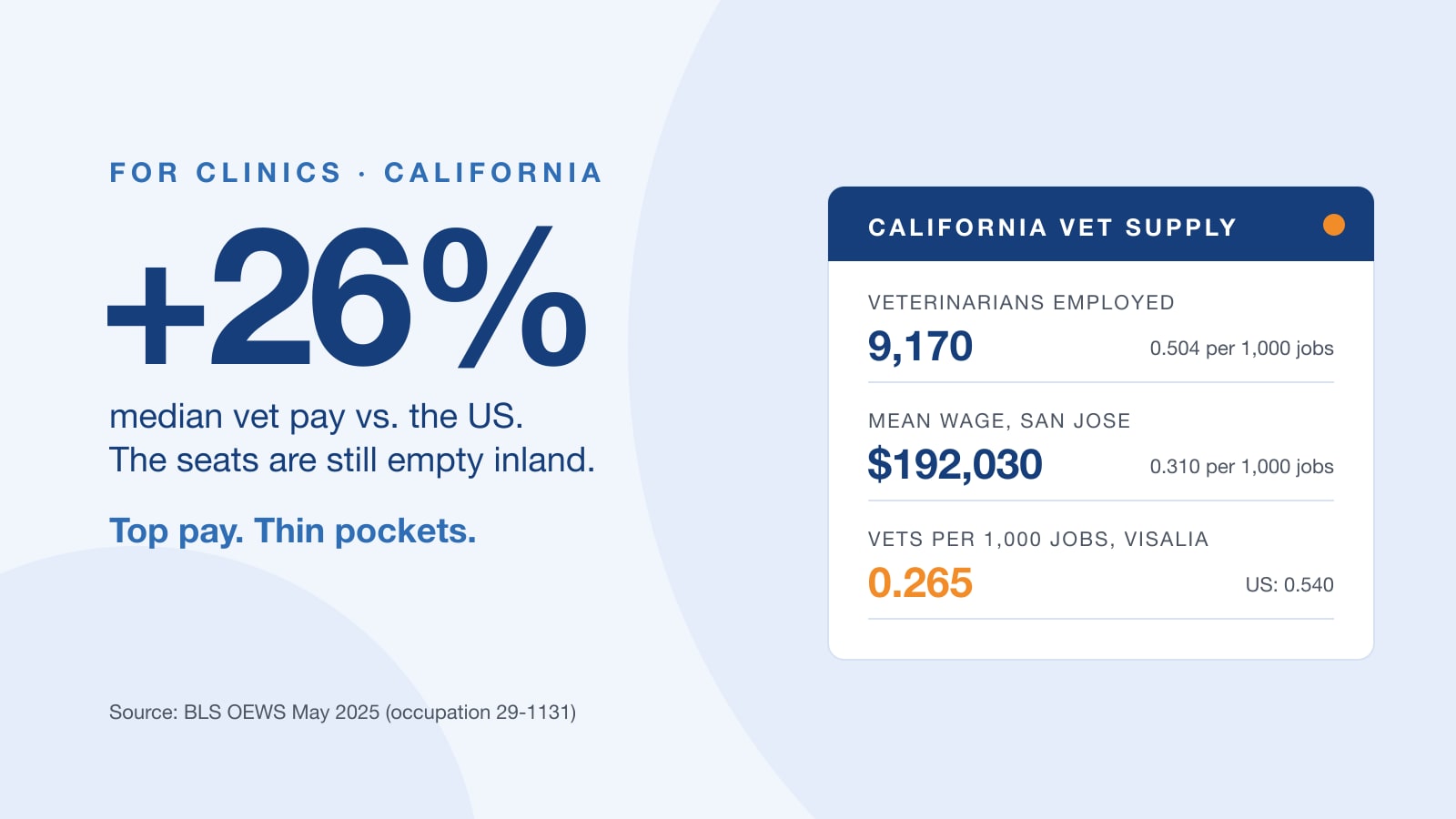
The short answer: California pays veterinarians well and still has large regions where clinics cannot find them. The Bureau of Labor Statistics counts 9,170 veterinarians employed in California as of May 2025. Statewide that is 0.504 vets for every 1,000 jobs against 0.540 nationally, a location quotient of 0.93, close to average. The statewide figure hides the problem. In San Jose, the Inland Empire and across the Central Valley, density falls to between about half and three quarters of the national rate, and high pay has not fixed it.
The California numbers
Employment: 9,170 veterinarians statewide, against 6,270 in Texas, 3,390 in New York and 83,900 nationwide (BLS Occupational Employment and Wage Statistics, May 2025). California alone employs about 11% of the country's veterinarians.
Pay: the annual mean wage for California veterinarians is $169,860, against $142,680 nationally. The median is $163,920, about 26% above the national median of $130,100. That is the opposite of what we found in our New York hiring breakdown, where veterinary pay lags the rest of the state's economy. In California it runs ahead: the all-occupation mean wage is about 16% above the national figure ($80,690 versus $69,770), while the veterinary mean is about 19% above.
Density: 0.504 veterinarians per 1,000 jobs, compared with 0.540 for the US and 0.446 in Texas, which we covered in our Texas hiring breakdown.
Where the shortage actually is
California is several hiring markets at once, and the BLS metro data shows how far apart they are.
The Bay Area pays the most. The San Francisco-Oakland metro reports an annual mean wage of $195,160 and a median of $208,080, and San Jose-Sunnyvale-Santa Clara a mean of $192,030. Yet San Jose has only 0.310 veterinarians per 1,000 jobs, about 43% below the national rate. Pay near the top of the national scale has not filled those seats.
Southern California is mixed. Los Angeles-Long Beach-Anaheim employs 2,740 veterinarians at a mean of $164,460 and 0.437 per 1,000 jobs. San Diego sits at 0.701, above the national average. Riverside-San Bernardino-Ontario, the Inland Empire, has 660 veterinarians at 0.387 per 1,000 jobs, roughly 28% below the national rate, even with a mean wage of $168,240.
The Central Valley is thinnest. Fresno has 0.361 veterinarians per 1,000 jobs, Stockton 0.327, Bakersfield 0.284 and Visalia 0.265, under half the national rate. This is farm country, where a practice often needs a doctor comfortable with livestock as well as companion animals, which narrows the pool further.
Sacramento is the outlier, with 0.768 veterinarians per 1,000 jobs and a mean of $177,250, the densest of the state's large metros. Our salary by state breakdown puts all of these figures in national context.
New graduate supply
California trains veterinarians at two schools. UC Davis enrolled 155 students in its class of 2029, drawn from a record of more than 3,000 applications, and 127 of the admitted students are California residents, according to its admission profile. Only 6 listed large animal and 5 listed food animal as their main area of interest, against 55 for small animal. Western University of Health Sciences in Pomona is the other school.
That pipeline is real, but every specialty hospital, emergency group and corporate chain in the state recruits from it. The AVMA's 2025 Graduating Senior Survey found that nearly 60% of new graduates had full-time jobs lined up before graduation. A Valley or Inland Empire clinic that starts recruiting in the spring is choosing from what is left.
What it takes to practice in California
California licenses veterinarians through the Veterinary Medical Board. An applicant needs a degree from an AVMA-accredited school or an ECFVG or PAVE certificate, a passing NAVLE score, fingerprint clearance, and the California Veterinary Law Examination for anyone who did not graduate from UC Davis or Western University.
Two details matter for international hiring. First, all five Canadian veterinary schools are AVMA-accredited, and so is UNAM's veterinary school in Mexico City for its 2011 to 2025 graduating classes. Those graduates qualify on the same footing as any US graduate. Our UNAM accreditation explainer covers that window.
Second, California recognizes experience. A veterinarian who passed the NAVLE more than five years ago does not automatically have to retake it: the Board also accepts recent clinical practice in another state or a Canadian province, or current continuing education. For an experienced Canadian veterinarian, that keeps the route to a California license straightforward.
What a California clinic should do now
Price the vacancy first. Every month a seat sits empty costs production, and our breakdown of what an empty DVM seat costs puts numbers on it.
Do not count on pay alone. San Jose pays near the top of the country and still has one of the thinnest benches in the state. Inland and Valley clinics are recruiting from the same small graduating classes as every coastal employer, so caseload, mentorship, schedule and the kind of medicine you practice have to carry part of the offer.
Widen the pool. The domestic supply is the same for every clinic in your region. A veterinarian from Canada or Mexico, licensed through the same California standard, is a candidate your competitors are not calling.
What VetBridge USA handles
VetBridge USA sources veterinarians from Canada and Mexico for independent US practices, matches them to your opening, and coordinates state licensing and the TN process end to end, with immigration work handled by licensed independent attorneys. You interview and you decide who you hire.
Sources
California, metro area, comparison state and national employment and wage figures come from the US Bureau of Labor Statistics, Occupational Employment and Wage Statistics, May 2025, occupation 29-1131 Veterinarians; percentage comparisons are calculated from those figures. All-occupation wage comparisons come from the same release. UC Davis class figures come from the UC Davis School of Veterinary Medicine Admission Profile for the Class of 2029. New graduate employment comes from the AVMA 2025 Graduating Senior Survey. Licensing requirements come from the California Veterinary Medical Board's Veterinary License Application guidance and Business and Professions Code section 4846. School accreditation comes from the AVMA Council on Education, the NAVLE is administered by the International Council for Veterinary Assessment, and TN eligibility for veterinarians comes from USCIS, TN USMCA Professionals.
Questions clinics ask
Is there a veterinarian shortage in California?
Statewide, supply is close to average: the BLS counts 9,170 veterinarians in California as of May 2025, or 0.504 per 1,000 jobs against 0.540 nationally. Regionally, it is a real shortage. San Jose has 0.310 per 1,000 jobs, the Inland Empire 0.387, and Bakersfield and Visalia under 0.290, roughly half the national rate.
How much do veterinarians make in California?
The BLS reports an annual mean wage of $169,860 and a median of $163,920 for California veterinarians as of May 2025, against a national median of $130,100. The San Francisco-Oakland metro has the highest figures in the state, with a mean of $195,160 and a median of $208,080.
What exams does a veterinarian need to practice in California?
The NAVLE, plus the California Veterinary Law Examination for anyone who did not graduate from UC Davis or Western University of Health Sciences, according to the California Veterinary Medical Board. Applicants also need a degree from an AVMA-accredited school or an ECFVG or PAVE certificate, and fingerprint clearance.
Can a veterinarian from Mexico or Canada get licensed in California?
Yes, through the same standard as any other applicant. All five Canadian veterinary schools are AVMA-accredited, as is UNAM in Mexico City for its 2011 to 2025 graduates. The California Veterinary Medical Board also accepts recent clinical practice in a Canadian province for experienced veterinarians whose NAVLE pass is more than five years old.